
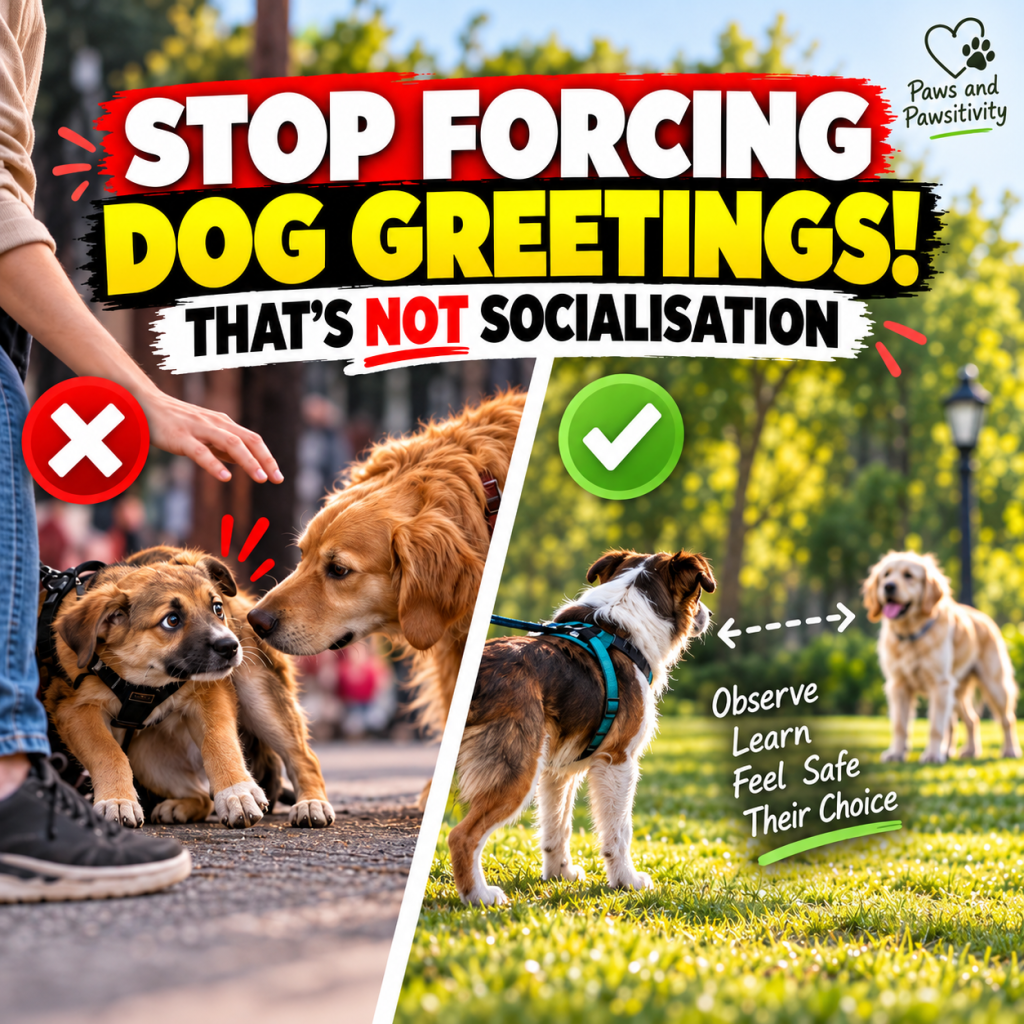
Socialisation is one of the most misunderstood parts of raising a dog. And sometimes, the advice given with the best intentions can leave a dog feeling overwhelmed rather than confident.
You’ve probably heard it before.
“You need to socialise your puppy.”
“Make sure they meet lots of other dogs.”
“Get them used to everyone while they’re young.”
There’s an important idea behind that advice. Early positive experiences can help puppies become comfortable with the world around them. But somewhere along the way, socialisation became confused with constant interaction.
And that’s where problems can begin.
Socialisation isn’t a numbers game
A puppy who has greeted twenty dogs isn’t necessarily better socialised than one who has calmly watched five dogs from a comfortable distance.
What matters is the quality of those experiences.
A puppy who is repeatedly approached by unfamiliar dogs, picked up by strangers or encouraged into situations they find frightening may learn that new experiences are unpredictable or difficult to escape.
That’s hardly the foundation we’re hoping to build.
Successful socialisation should help a dog develop positive associations with the environments, people, animals, sounds and situations they may encounter throughout life.
That doesn’t mean they need direct contact with everything.
Sometimes the most valuable experience is simply watching the world go by.
Why observation matters
Imagine sitting with your puppy on a quiet bench, watching people walk past.
A cyclist approaches. Your puppy notices, looks towards the bicycle and remains relaxed.
You offer a treat. The cyclist continues past, and nothing uncomfortable happens.
That can be a worthwhile socialisation experience.
Your puppy has encountered something new without being pressured to interact with it.
Over time, carefully managed experiences like these can help dogs learn that unfamiliar sights and sounds don’t necessarily require a response.
Of course, distance matters. If your puppy is visibly struggling, moving further away is often more helpful than remaining in place and hoping they’ll get used to it.
Your dog’s body language matters more than your plans
Perhaps you’ve arranged to meet another dog, but your puppy is hanging back, repeatedly looking away or trying to increase the distance.
It’s tempting to encourage them forward because you’ve made the effort to arrange the experience.
But socialisation isn’t a task to tick off.
Behaviour needs to be understood in context, taking account of the dog’s whole body, the environment and what happened before and during the interaction.
A dog moving away may be communicating that they need more space. Respecting that choice can help prevent an uncomfortable encounter from becoming overwhelming.
And remember, a wagging tail or willingness to take food doesn’t automatically mean a dog is comfortable.
Look at the whole picture.
Why forcing socialisation can backfire
There’s an important difference between gently introducing your dog to something unfamiliar and overwhelming them with an experience they cannot manage.
Exposing a frightened puppy to an intense situation and waiting for them to stop reacting is not a reliable way to build confidence.
A quieter dog isn’t necessarily a more comfortable dog.
This is why force-free, fear-free approaches prioritise manageable exposure, choice and the ability to move away.
The aim is to give your dog opportunities to learn while keeping them within a level of stimulation they can cope with.
Does socialisation end after puppyhood?
No.
Puppyhood includes an important early period for social development, but dogs continue learning throughout their lives.
Adult dogs can benefit from carefully planned, positive experiences too.
Their individual histories, health, temperament and previous experiences will influence what they find comfortable.
And here’s something worth remembering: your dog does not have to enjoy interacting with every other dog.
Being able to pass another dog calmly, without greeting them, can be a far more useful everyday skill.
Watch the full episode
In Series 4, Episode 8 of Paws and Pawsitivity, What Socialisation Actually Means, I explain how to approach socialisation with more understanding and less pressure.
We explore safe exposure, body language, choice, positive reinforcement and why simply observing can be more helpful than another forced greeting.
🎥 Watch the episode on YouTube:
What Socialisation Actually Means | Paws and Pawsitivity
If you’re preparing for a puppy or supporting a dog who finds the world difficult to navigate, this is an episode worth watching.
And if someone you know believes socialisation means their puppy must say hello to everybody, please share it with them.
Need professional dog training support?
At Pawfect Training Academy, I provide online consultations and personalised training programmes built around positive reinforcement, welfare and each dog’s individual needs.
I also specialise in helping dogs experiencing separation anxiety, using carefully structured, force-free support.
Visit https://pta.dog to explore my services and take the next step towards understanding your dog.
Because successful socialisation isn’t about making your dog love everything. It’s about helping them navigate the world feeling safe.
If you’re ready to level up your dog’s training, hit that play button and join me for this exciting episode of Paws and Pawsitivity! 🐾
🎧 Listen to the full episode now!


Enjoyed this post?
Don’t just close the tab, help spread the pawsitivity!
👉 Like the post to show your support
👉 Share it with fellow dog lovers
👉 Subscribe so you never miss out on future tips and insights
Your clicks really do count, and every share helps more dogs (and humans) discover the power of kind, ethical training. 🐾
Enrich Your Dog’s Day, Every Day
Before you go, treat your pup to something special. K9 Connectables offers mental stimulation and enrichment that aligns perfectly with a force-free training lifestyle. Because a tired dog isn’t always a happy one – but a fulfilled dog is.
CLICK HERE or on the image below to explore K9 Connectables and enjoy 10% off, thanks to our special partnership with K9 Connectables. Your dog will thank you for it! Or simply use code PTA10 at checkout!

It’s one small change that can make a big difference, starting today.