
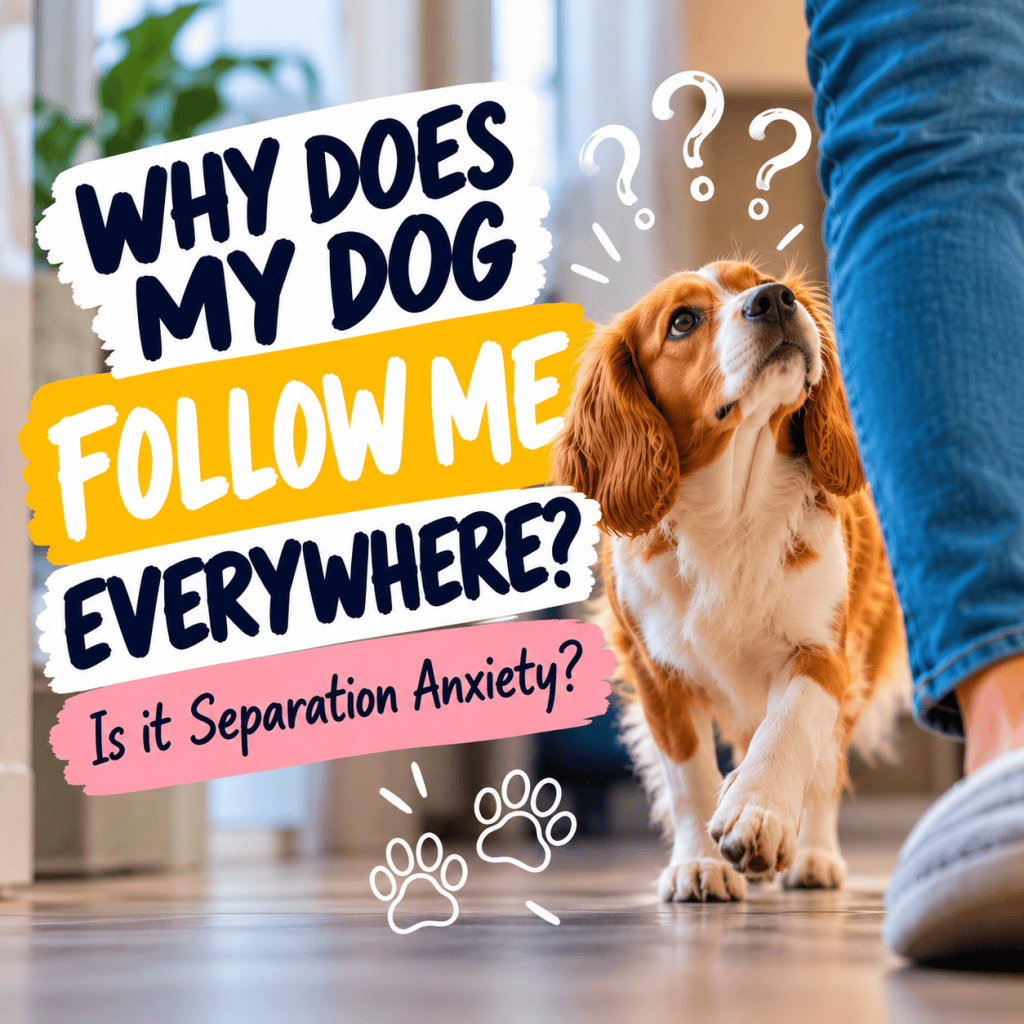
You stand up and your dog stands up.
You walk into the kitchen and they are right behind you.
You go upstairs and apparently they need to investigate that too.
Even a trip to the bathroom can become a group activity.
If your dog follows you everywhere, it can be tempting to wonder whether they have become too attached to you. And once separation anxiety enters the conversation, normal closeness can suddenly start to look worrying.
But following you around the house, by itself, does not tell us that a dog has separation anxiety.
Why does my dog follow me everywhere?
There can be many reasons.
Dogs live incredibly closely alongside us, and our movements often provide useful information. Walking towards the kitchen might mean food. Picking up a lead could predict a walk. Sitting on the sofa might mean an opportunity for a cuddle.
Sometimes your dog may simply want to know what you are doing.
Dogs can also differ enormously as individuals. Some naturally choose to spend more time close to their guardians, while others are perfectly content snoozing in another room.
Following may also be particularly noticeable when a dog has recently joined a home. A newly adopted dog or puppy is learning an enormous amount about their new environment, including household routines, unfamiliar sounds and what the people around them do.
Rather than immediately labelling their behaviour, give them the opportunity to adjust.
Look at what happens when your dog does not follow
This is where things become much more informative.
If you leave the room, can your dog remain on the sofa and continue sleeping?
Can they follow you into the kitchen, discover that absolutely nothing interesting is happening, and wander off again?
Can they choose to settle somewhere away from you?
Being close to you and being unable to cope without access to you are not the same thing.
What deserves closer attention is the wider pattern.
If your dog repeatedly becomes alert whenever you move, struggles to remain settled when you leave a room, cannot disengage from monitoring you, or shows concerning behaviour when access to you changes, it may be worth investigating further.
That still does not mean automatically diagnosing separation anxiety.
We need to understand what is actually happening.
What happens when your dog is genuinely alone?
If you are worried about separation anxiety, a camera can provide extremely useful information.
Rather than judging your dog’s ability to cope based solely on what happens while you are home, you can observe what happens around your departure and during the absence itself.
Can your dog settle and rest?
Or do you see persistent pacing, repeated vocalisation, attempts to escape, an inability to settle or other concerning changes associated with separation?
Similar-looking behaviours can also have different causes. Barking could be connected to something happening outside. Difficulty behind a closed door could involve confinement distress. A young dog wandering around looking for something to do may have very different needs from a dog experiencing genuine fear or panic during separation.
This is why we should investigate before we label.
A sudden change in behaviour should also make us consider health and pain. If a dog who previously rested independently suddenly begins following their guardian constantly, the wider picture matters and veterinary involvement may be appropriate.
You do not need to push your dog away
If your dog enjoys being close to you, you do not need to start withholding affection because somebody has told you they are “too attached”.
Comfortable independence can be encouraged positively.
We can make alternative resting places appealing, reinforce dogs when they choose to settle elsewhere and give them opportunities to relax without constant interaction.
There is an important difference between a dog choosing to rest independently and being deliberately isolated in an attempt to force independence.
So if your dog is your little four-legged shadow, look beyond the following itself.
Look at choice.
Look at context.
Look at whether they can settle and disengage.
And if you are concerned about separation anxiety, look at what actually happens when they are separated from you.
Watch this episode of Paws and Pawsitivity here:
👉 CLICK HERE TO VIEW THE EPISODE 👈
If your dog struggles when left alone and you would like professional support, Pawfect Training Academy offers online consultations and personalised separation anxiety training programmes.
If you’re ready to level up your dog’s training, hit that play button and join me for this exciting episode of Paws and Pawsitivity! 🐾
🎧 Listen to the full episode now!


Enjoyed this post?
Don’t just close the tab, help spread the pawsitivity!
👉 Like the post to show your support
👉 Share it with fellow dog lovers
👉 Subscribe so you never miss out on future tips and insights
Your clicks really do count, and every share helps more dogs (and humans) discover the power of kind, ethical training. 🐾
Enrich Your Dog’s Day, Every Day
Before you go, treat your pup to something special. K9 Connectables offers mental stimulation and enrichment that aligns perfectly with a force-free training lifestyle. Because a tired dog isn’t always a happy one – but a fulfilled dog is.
CLICK HERE or on the image below to explore K9 Connectables and enjoy 10% off, thanks to our special partnership with K9 Connectables. Your dog will thank you for it! Or simply use code PTA10 at checkout!

It’s one small change that can make a big difference, starting today.